

"Automate with AI" mostly gets illustrated with demos that fall over in production. This list is deliberately duller: ten processes we see reliably automated in real businesses, with the failure modes stated. The pattern behind all ten: automation platforms handle the plumbing, AI handles classification and drafting, and a human handles anything with consequences.
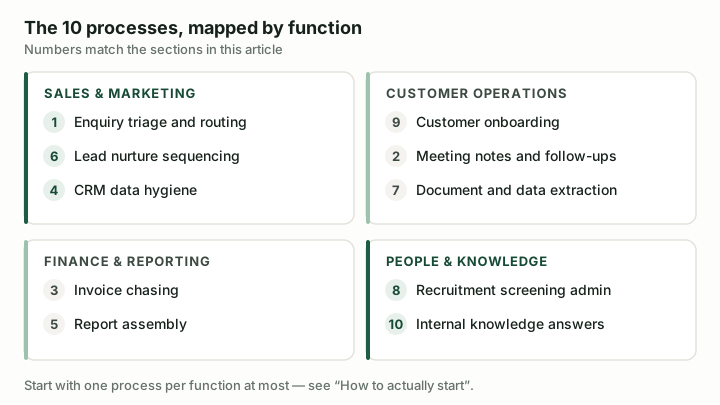
The ten processes at a glance, grouped by the function that owns them. Numbers match the sections below.
1. Enquiry triage and routing
Every inbound enquiry (web form, email, portal) gets classified by AI — sales, support, supplier, spam — extracted into structured fields, and routed: sales enquiries into the CRM with an assigned owner and a follow-up task, support requests into the helpdesk. Payback: first-response time drops from hours to minutes. Keep human: anything the classifier scores low-confidence goes to a person, not a guess. We cover this end-to-end in our enquiry automation tutorial.
2. Meeting notes and follow-ups
Record, transcribe, summarise, extract action items, draft the follow-up email — and stop there. A person reviews and sends. Payback: 20–30 minutes per meeting, and follow-ups actually happen. Keep human: the send button. AI summaries still misattribute commitments occasionally, and a wrong "you agreed to..." email costs trust.
3. Invoice chasing
Rule-based, not AI-heavy: overdue invoice triggers a polite reminder sequence with escalating firmness, pausing automatically when payment lands or the customer replies. AI's role is limited to detecting replies that need human attention ("we dispute this invoice"). Payback: debtor days fall measurably; awkwardness is outsourced to a robot that never feels awkward.
4. CRM data hygiene
Automations that create follow-up tasks for stale deals, flag records missing critical fields, de-duplicate on defined rules, and enrich new contacts from public data. Payback: the CRM stays trustworthy, which protects every other process built on it. Honest note: this one is unglamorous and has the best ROI-to-effort ratio on the list.
5. Report assembly
The monthly management pack that someone assembles from five systems by hand: automations pull the figures on schedule, populate a template, and circulate a draft. AI can draft the variance commentary — flagging what moved and by how much — for a human to edit. Keep human: interpretation. "Why it moved" is a judgement with consequences.
6. Lead nurture sequencing
Behaviour-triggered email journeys — downloaded a guide, visited pricing twice, went quiet for 30 days — with AI drafting variants for testing. Dedicated marketing automation (ActiveCampaign is our usual pick at SME scale) does this better than general-purpose automation platforms. Keep human: the journey design and the copy that ships.
7. Document and data extraction
Invoices, purchase orders, delivery notes, application forms: AI extraction into structured data, validated against rules (totals add up, supplier exists), with exceptions queued for review. Payback: substantial where volume exists. Honest note: accuracy is high but not perfect — the validation rules and exception queue are not optional extras, they are the design.
8. Recruitment screening admin
Parsing applications into structured candidate records, scheduling interviews, sending status updates. Keep human — emphatically: the screening decision itself. Using AI to reject candidates is legally sensitive in several jurisdictions and ethically questionable everywhere. Automate the admin around the decision, never the decision.
9. Customer onboarding
New customer signed: provision accounts, send welcome sequence, create the delivery project from a template, schedule the kick-off, notify the team. Almost entirely rule-based — AI adds little here, and that is fine. Payback: consistent first impressions and no forgotten steps; this is often the easiest first automation because the trigger and steps are unambiguous.
10. Internal knowledge answers
An AI assistant over your own documentation — policies, SOPs, product specs — answering staff questions with citations to the source document. Keep human: treat answers as signposts, not authority; keep the underlying documents current or the assistant confidently serves stale policy. Retrieval quality depends entirely on documentation quality.
How to actually start
Pick one process — the one where hours visibly disappear each week. Map it on paper first: trigger, steps, exceptions, error route. Build the smallest version, run it alongside the manual process for two weeks, measure, then expand. The businesses that fail at automation buy tools first and map processes never.
Full hands-on testing of several AI services referenced in this guide is in progress; recommendations reflect documented capabilities and our implementation experience in client automations.
Sources & further reading
- McKinsey — The State of AI — adoption and value data behind the business case
- Microsoft Work Trend Index — AI-at-work statistics, methodology published
- Zapier automation statistics — SME automation data (vendor research; disclosed as such)