HubSpot vs Pipedrive vs Zoho CRM, answered first: pick HubSpot if marketing, sales and service should share one record and adoption matters most; pick Pipedrive if the job is pipeline discipline for a sales team; pick Zoho CRM if you want the most capability per dollar and can invest in configuration. As of September 2026, paid plans start at about $15 per seat per month for HubSpot Starter and $14 per user per month for both Pipedrive Lite and Zoho CRM Standard — so the entry price decides nothing. What decides it is where each product's price goes next, and what your team will actually use.
HubSpot vs Pipedrive vs Zoho CRM: which should you choose?
| Your situation | Choose | Why |
|---|---|---|
| Marketing, sales and support should live on one contact record | HubSpot | The platform play; nothing to integrate |
| You need a free CRM that a team will actually adopt | HubSpot (free, up to 2 users) or Zoho CRM (free for 3 users) | Both are genuinely usable; Pipedrive has no free plan |
| A dedicated sales team needs pipeline discipline, fast | Pipedrive | The best pipeline experience in the class, quickest to roll out |
| Budget is the binding constraint at 10+ seats | Zoho CRM | Deep automation and customisation at prices the others cannot approach |
| Unusual processes, custom modules, an integrated back-office suite | Zoho CRM | Blueprint, custom modules and the wider Zoho suite |
| Nobody has time to configure anything | Pipedrive or HubSpot | Zoho rewards setup effort and punishes its absence |
Comparison
HubSpot vs Pipedrive vs Zoho CRMThe three small-business CRM finalists, compared criterion by criterion.
The card above opens our side-by-side table, generated from the HubSpot, Pipedrive and Zoho CRM profiles, so scores and pricing reflect our current assessment.
How do the three CRMs compare on pricing and features?
| HubSpot | Pipedrive | Zoho CRM | |
|---|---|---|---|
| Free plan | Yes — up to 2 users | No — 14-day trial | Yes — 3 users |
| Entry paid plan | Starter: from $15/seat/month | Lite: $14/user/month (annual billing) | Standard: $14/user/month (annual billing) |
| Where serious automation starts | Professional: $90/seat/month (annual; $100 monthly) plus a one-off $1,500 onboarding fee | Growth and Premium tiers | Professional and Enterprise editions |
| Top published tier | Enterprise: from $150/seat/month plus $3,500 onboarding | Ultimate: $79/user/month | Ultimate: $52/user/month |
| Scope | Sales, marketing, service, content, operations | Sales pipeline first; add-ons for leads, campaigns, projects | Sales CRM inside the wider Zoho business suite |
| AI | Breeze assistant and agents, metered by HubSpot Credits | AI sales assistant, email and report helpers | Zia: scoring, predictions, anomaly alerts |
| Ease of adoption | Highest | High | Moderate — configuration decides |
| Digital4All score | 8.6 / 10 | 8.2 / 10 | 8.0 / 10 |
Table: HubSpot vs Pipedrive vs Zoho CRM, as of September 2026. HubSpot figures from HubSpot's Sales Hub pricing page; Pipedrive and Zoho figures in USD from each vendor's pricing as recorded on our listings. Zoho's pricing page serves local currency, and Pipedrive renamed and repriced its plans in 2026 — confirm the current figure for your region before budgeting.
What is the one-paragraph difference between them?
HubSpot is the platform play: sales, marketing and service on one contact record, unbeatable ease of adoption, a genuinely free starting tier — and a steep climb into Professional pricing when you need the serious features. Pipedrive is the specialist: the best pipeline experience in the class at a transparent per-seat price, with marketing and service deliberately out of scope. Zoho CRM is the value engineer's choice: automation, customisation and AI at prices the others cannot approach, paid for in configuration effort and rougher polish.
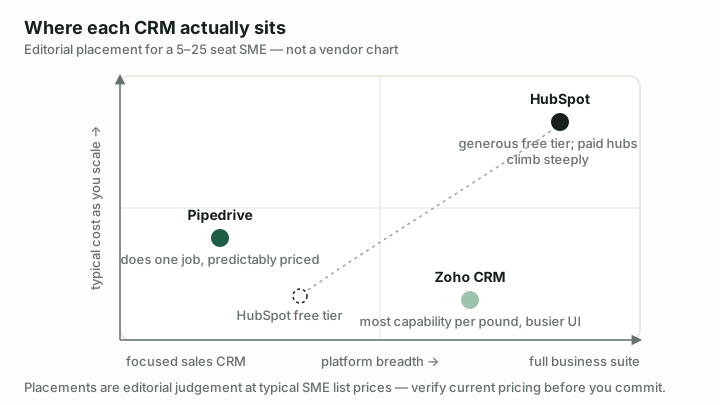
Editorial placement for a 5–25 seat SME — breadth against realistic cost, free tiers noted. Not a vendor chart.
Which CRM is cheapest once you price it properly?
Headline per-seat prices mislead in a different direction for each product.
HubSpot looks cheapest — a free tier, a modest Starter price — until the features you wanted turn out to live at Professional. As of September 2026 HubSpot's pricing page lists Sales Hub Professional at $90 per seat per month on annual billing, plus a one-off $1,500 onboarding fee, and AI agents draw on a monthly allowance of HubSpot Credits. Price that tier from day one.
Pipedrive's sticker price is the most honest of the three: what you see per seat is broadly what you pay, which is part of why finance teams warm to it. The catch is add-ons — lead generation, web visitors, campaigns and projects are priced separately on lower tiers.
Zoho's low prices are real. Budget the configuration investment — internal time or a partner — that converts them into value.
| Ten sales users, first year | Software cost | What is not included |
|---|---|---|
| HubSpot Sales Hub Professional | about $12,300 ($90 × 10 × 12, plus $1,500 onboarding) | Marketing Hub, if you want the platform story |
| Pipedrive Ultimate | about $9,500 ($79 × 10 × 12) | Add-ons on lower tiers; no marketing or service tools |
| Zoho CRM Ultimate | about $6,200 ($52 × 10 × 12) | Configuration time or a partner |
Table: arithmetic on vendor-published annual-billing prices as of September 2026, top published tier of each for a like-for-like ceiling. Most ten-person teams buy a middle tier and pay less.
The most reliable method we know is boring: model total cost over 24 months — seats, tier, add-ons, implementation — for your genuine 18-month feature list, and let that number argue with the demos.
Which is easiest to set up and use?
Pipedrive is the fastest to roll out: import contacts, define pipeline stages, connect email, and a sales team is working the same afternoon. Its narrowness is a feature — there is less to configure and less to ignore.
HubSpot is nearly as quick for the CRM itself and has the best onboarding, templates and academy of the three. Its breadth is the adoption risk: a team that only needed a pipeline can feel lost in a platform.
Zoho CRM takes the longest. Out of the box it is serviceable; configured — layouts, Blueprint processes, validation rules, workflow — it is formidable. The difference between configured and unconfigured Zoho is the difference between a bargain and a disappointment.
Which has the best automation and AI?
For automation depth per dollar, Zoho: workflow rules, Blueprint process enforcement, custom functions and approval processes arrive on editions that cost less than the others' mid-tiers. HubSpot's workflows are the most pleasant to build and extend across marketing and service, but they start at Professional. Pipedrive's automation is simpler and focused on sales activities — enough for most sales teams, not a process engine.
On AI, all three are shipping quickly — HubSpot's Breeze agents, Pipedrive's AI assistant, Zoho's Zia — and we have not re-evaluated the 2026 releases in depth, so we would not choose on AI alone. Today's gaps will narrow.
All three connect to the outside world through automation platforms; if your CRM must talk to forms, finance or support tools, read Make vs Zapier alongside this page.
Which is best for marketing, reporting and the rest of the business?
If marketing automation, landing pages and a service desk belong in the same system, HubSpot wins by design. Pipedrive leaves those jobs to other tools. Zoho answers with the rest of its suite — Campaigns, Desk, Books, Analytics — which is cheaper than HubSpot and less seamless.
For reporting beyond the built-in dashboards, all three can feed a BI layer; small teams usually start with Looker Studio, which is free. And the enquiries a CRM manages have to come from somewhere — our guide to the best SEO tools for small business covers the top of that funnel.
When the business outgrows a CRM bolted to accounting software, the CRM question becomes an ERP question: ERPNext includes a CRM module in its open-source suite, and Dynamics 365 Business Central pairs with Microsoft's own sales tools.
Can you migrate between these CRMs later?
Yes. Contacts, companies and open opportunities move cleanly by CSV or a migration tool; activity history, email threads, automations and custom reports mostly do not. The practical advice: start on the product you expect to be using in two years, keep custom fields disciplined, and never let the free tier become a strategy by accident.
Who should not choose each one?
Skip HubSpot if you need Professional features but cannot fund Professional pricing — Starter will frustrate you.
Skip Pipedrive if marketing or support must share the system, or if you need a free plan.
Skip Zoho CRM if nobody will own configuration, or if polish and adoption matter more than depth.
We would also not shortlist more than these three plus at most one situational candidate; selection fatigue produces worse decisions than a disciplined shortlist. And do not decide from demos — run your own scenarios with your own data during trials.
What does Digital4All recommend?
For most small businesses choosing a first real CRM: HubSpot free or Starter if marketing will share the system, Pipedrive if it is purely a sales tool. For cost-sensitive teams of ten or more with someone who enjoys configuration: Zoho CRM. For the wider context — including when none of the three is right — see our guide to the best CRM software for small businesses, or browse every CRM we list under CRM and sales.
If you want the shortlist pressure-checked against your process, or the chosen CRM configured and migrated, see CRM selection and CRM implementation, or tell us about your sales process.
How we evaluated HubSpot, Pipedrive and Zoho CRM
All three carry scored Digital4All profiles (HubSpot 8.6, Pipedrive 8.2, Zoho CRM 8.0 out of 10) based on implementation work in client accounts on each platform; the criteria — ease, automation, AI, support, value — and the scores live on the listing pages. Pricing was re-read in September 2026: HubSpot's from HubSpot's Sales Hub pricing page on 18 September 2026; Pipedrive's and Zoho's USD figures from our listings, because Pipedrive's pricing page could not be retrieved on the day and Zoho's serves local currency. The 2026 AI releases from all three vendors have not been re-evaluated by Digital4All, and this page makes no comparative claim about them. Updated 18 September 2026: decision table, pricing and feature table, ten-user cost example, HubSpot onboarding fees and credits, and sections on setup, automation and migration.
Sources & further reading
- HubSpot Sales Hub pricing page — Free, Starter, Professional, Enterprise; onboarding fees; HubSpot Credits (accessed 18 September 2026)
- Pipedrive pricing page — Lite, Growth, Premium, Ultimate; plans renamed and repriced in 2026 (as recorded on our listing, August 2026)
- Zoho CRM pricing page — Free, Standard, Professional, Enterprise, Ultimate; USD list prices (accessed September 2026; page serves local currency)